A Basketball Screen: Watch the Defender's Choice
A basketball screen makes the defender choose how to respond. Learn to read the choice, spot its cost, and see how it shapes the next pass or shot.
The common mistake when reading a basketball screen is to watch only the ball-handler. That hides the defender’s choice, which often decides whether the possession produces a clean shot, a contested drive, or an awkward scramble. A screen is easier to understand when you track the two defenders involved and ask what each is trying to protect.
What decision does the screen create?
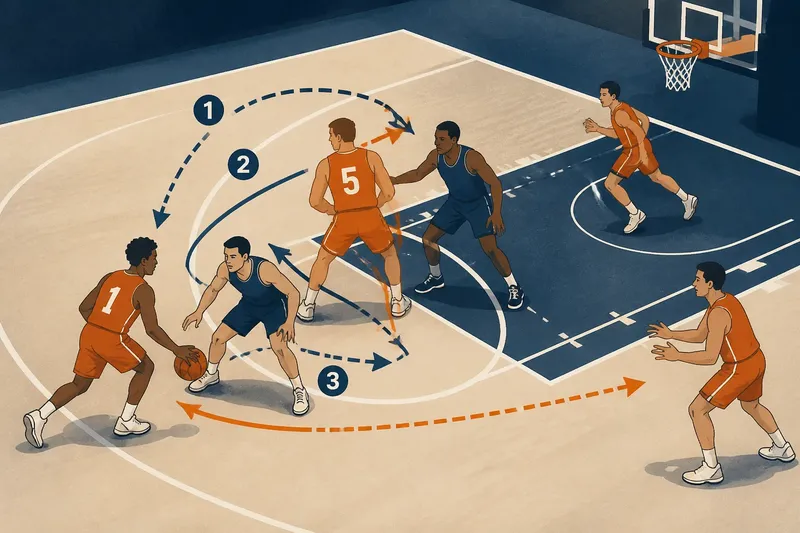
Imagine a hypothetical possession late in a close game. The offense has the ball near the top of the arc. Its point guard dribbles toward the right, while a teammate approaches to set a screen just outside the lane. The defender guarding the point guard is close enough to influence the dribble; the screener’s defender is positioned nearer the basket.
The screen blocks or delays the first defender’s direct route to the ball-handler. That defender now has to choose among following the dribbler around the screener, switching to guard the screener’s player, or finding a route through or around the screen while staying with the original assignment. The choice is not a diagram on a board. It is a response to the ball-handler’s movement, the screen’s position, and the help behind the play.
For the viewer, the useful question is not simply whether the screen “worked.” Ask which defender took responsibility for the ball-handler after the screen, and what space that decision left open.
What happens if the defender follows?
In the hypothetical possession, the point guard’s defender can chase around the screener’s outside shoulder. This is the follow or “go over” response: the defender stays attached to the ball-handler’s assignment, even if the route takes longer. The screener’s defender remains responsible for the screener’s player and may step toward the dribbler to slow the drive.
If the first defender gets back in front, the offense may gain little beyond a momentary change of direction. If the defender trails behind, though, the ball-handler can turn the corner with room to advance. The second defender must then decide whether to contain the drive or stay near the screener, who may be moving toward the basket.
Watch the defender’s path and the screener’s defender together. A trailing defender with no help in front is a different situation from a trailing defender whose teammate has stepped into the dribbler’s route.
When does a switch change the matchup?
Suppose the screener’s defender steps out and takes the point guard, while the original defender turns to cover the screener. That is a switch: the defenders exchange assignments rather than trying to preserve the original matchups. It can prevent the ball-handler from gaining a clear path around the screen, because a defender is already in front.
The cost may appear after the exchange. The new ball-handler defender could be less suited to guarding a quick dribble, while the original point guard’s defender may now be matched against a larger player near the basket. The offense can keep the ball moving, attack one of those matchups, or use the screener’s movement to test whether the defenders have communicated.
In our invented situation, the two defenders switch cleanly. The point guard slows rather than forcing a drive, and the screener rolls toward the rim. The original defender, now guarding the roller, stays between that player and the basket long enough for a third defender to help. The ball-handler passes to the wing instead of taking a difficult shot.
A switch is therefore not automatically a mistake or a success. Read whether the exchange closes the immediate opening, then look for the matchup or passing lane it leaves behind.
Can the defender get around the screen?
The third option is to navigate around the screener and remain with the original assignment. The defender may go over the screen, squeeze between the screener and the ball-handler, or go under it by taking a route closer to the basket. Which route makes sense depends on the ball-handler’s shooting threat, the screen’s angle, and the space available.
Going under can preserve a shorter path back to the ball-handler, but it gives that player room to stop and shoot. Going over can make a shot harder, but it may leave the defender chasing from behind. A tight route through the gap can keep contact with the play, though the screener may make that passage difficult.
In the hypothetical possession, the defender begins to go under. The point guard pauses beyond the screen and raises the ball into a shooting position. The defender turns back toward the shooter, while the screener’s defender steps forward to deter the shot. The point guard sees the roller moving behind that help and passes to them. The defense has prevented the immediate jumper but now has to recover toward the basket.
The visible route tells only part of the story. Notice whether the defender is still close enough to contest the ball-handler and whether another defender has moved to cover the space that was left.
How can you read the whole possession?
Return to the invented play: the switch closes the first driving lane, the ball-handler passes to the wing, and the defense rotates toward the pass. The offense has not scored from the screen itself, but the screen has forced defenders to exchange assignments and then move again. The next opportunity may come from a late closeout, a pass to the roller, or a reset that brings the ball back to the top.
To follow the sequence without losing the ball, watch in this order:
- Find the defender guarding the ball-handler before contact with the screen.
- Identify the screener’s defender and note whether that player stays back, steps out, or moves toward the basket.
- Track who guards the ball-handler after the screen: the original defender, the screener’s defender, or a third defender.
- Look at the screener’s next movement and the space it opens or occupies.
- Follow the next pass and check whether the defense has recovered to the receiver.
This is a way to read responsibility, not a claim that every team uses the same coverage. The same defender might be asked to switch in one situation and stay with the screener in another. The on-court result depends on the players’ assignments and how the rest of the defense responds.
What should you look for after the first choice?
How do you spot a switch?
Watch for the original ball-handler defender turning toward the screener’s player while the screener’s defender takes the dribbler. The exchange may happen quickly, so use who is guarding whom after the screen rather than assuming a switch from body contact alone.
Why does a defender go under a screen?
Going under gives the defender a shorter route back to the ball-handler and can help keep the drive in front. It also leaves more room for a shot, so the ball-handler’s position and the defense’s nearby help matter.
What is the screener’s defender doing?
That defender may stay near the basket, step toward the ball-handler, or take over the dribbler in a switch. Their movement reveals whether the defense is trying to protect the rim, pressure the ball, or exchange assignments.
Does a successful screen always create a shot?
No. A screen can make a defender choose without producing an immediate open look. Its effect may be a changed matchup, a temporary gap, or a pass that forces the defense to rotate.
What is the useful lesson from this possession?
The invented point guard’s possession ends with a pass rather than a shot, but the screen still shapes the play: it changes who guards the ball, draws help toward the roller, and gives the offense a chance to move the defense. The result is not proof that one response is best. It shows why the defender’s choice is the most revealing moment to watch.
When reading a basketball screen, keep your attention on the defender’s route, the assignment after the screen, and the space the choice leaves. Then follow the next action. The clearest clue may arrive after the ball has already moved.