The Offside Line Is a Snapshot, Not a Fence
Understand the offside line by tracking the instant a teammate plays the ball, so you can judge runs, passes, deflections and resets more clearly.
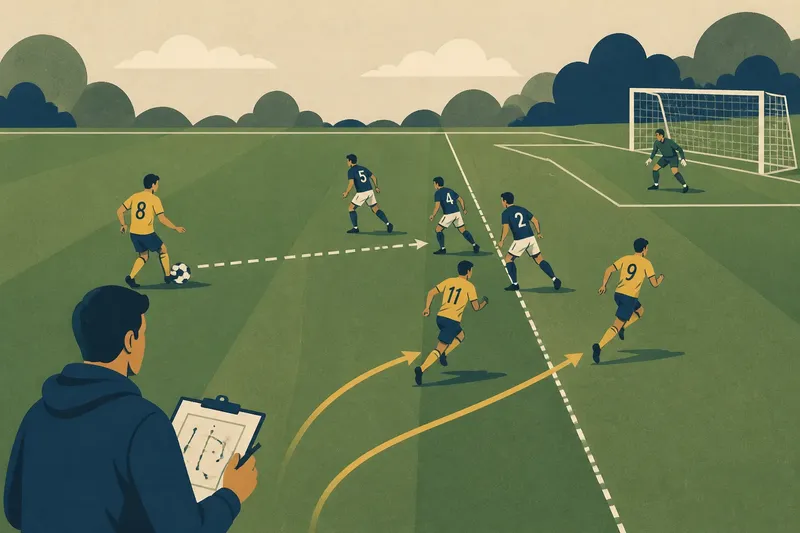
The common mistake in judging offside is to freeze the picture when the attacker receives the ball. By then, the decisive moment has passed: offside position is assessed when a teammate plays or touches the ball, and a run that looked legal a moment earlier may already have crossed the line. Treat the offside line as a snapshot, not a fence that attackers must stay behind throughout the move.
That distinction changes how you watch a pass, coach a run or interpret a flag. The attacker’s later position matters, but it does not decide whether the original position was offside. The useful habit is to connect two moments: where the attacker stood when the ball was played, then what the attacker did afterward.
What does the offside snapshot capture?
Under the Laws of the Game, being in an offside position is not itself an offense. An attacker must be in the opponents’ half, nearer to the opponents’ goal line than both the ball and the second-last opponent, and then become involved in active play in one of the specified ways. The goalkeeper counts as an opponent, but is not automatically the last defender; the second-last opponent may be an outfield player.
The comparison is made at the instant a teammate plays or touches the ball. For this judgment, the relevant parts of the attacker’s head, body or feet are considered; hands and arms do not count for any player, including the goalkeeper. Being level with the second-last opponent or level with the ball is onside.
The snapshot does not mean every body must remain in place. A player can start in an offside position, move back onside before a teammate plays the ball, and be onside for that later pass. Conversely, a player may start onside, sprint beyond the defenders, and be caught offside if the teammate releases the pass after the runner has gone beyond the relevant line.
Watch the passer’s contact, not the receiver’s arrival.
How can you read the timing across a week?
A short practice routine can make the timing easier to see without turning every match into an argument about a frozen frame. Use a week to isolate the decision, then add movement and match-like choices. The plan is for observation and low-risk practice; any organized drill should follow the coach’s instructions and the rules for the players’ age and competition.
- First session: find the instant. Watch a short passage of play and pause at the moment the passer touches the ball. Ignore where the receiver ends up for the moment. Identify the ball, the second-last opponent and the attacker who may receive the pass.
- Second session: compare two frames. Look at one image just before the pass and one at the pass. Ask which attackers changed position between them. A broadcast replay can help, but camera angle and frame timing can make close calls look more definite than they are.
- Third session: rehearse the cue. In a small, supervised passing exercise, have a coach or teammate call the instant the ball is played. The runner can learn to notice that contact rather than judging only by the defender’s location when the ball arrives.
- Fourth session: add a choice. Have the passer choose between an early ball and a delayed ball. The runner should respond to the actual release, not assume the pass will arrive at a preselected moment.
- Fifth session: review the whole action. Follow a few attacking moves from the passer’s touch through the receiver’s next action. Decide first whether there was an offside position at the snapshot, then whether the player became involved in active play.
When the view is unclear, do not force a confident call. Mark the moment as uncertain and look for a better angle or a clearer replay. The point of the routine is to improve the question being asked, not to make every marginal decision seem obvious.
What happens when the pass is delayed or redirected?
A delayed pass creates a new snapshot when the teammate eventually plays the ball. If the runner began onside and moves beyond the defenders while the passer waits, the runner’s position at release is the relevant one. If the runner began in an offside position but returns to an onside position before the teammate plays the ball, the later snapshot may put the runner onside.
Imagine a made-up practice move in which a winger waits level with the second-last opponent while a midfielder carries the ball. The winger starts a run early, but the midfielder takes another touch before passing. If the winger is beyond the second-last opponent at that later touch and then plays the pass, the expected observable outcome is an offside decision if the winger becomes involved in active play. The run’s starting point does not rescue the timing of the release.
A teammate’s touch also matters when the ball changes direction. If a pass is deflected by a defender, that does not automatically reset the offside situation; an attacker who was already in an offside position can still be penalized for becoming involved. A deliberate play by an opponent is different from a deflection, and the referee judges whether the opponent deliberately played the ball under the Laws.
A deliberate save does not reset the situation either. If a defender or goalkeeper saves a ball that was going into or close to the goal, an attacker who was in an offside position may still be penalized for playing or challenging for the ball. A ricochet is not a universal reset button, despite its popularity in post-match explanations.
When does an offside-positioned player become involved?
Position alone does not stop play. The decision also depends on what the player does after the teammate’s touch. The relevant involvement can include playing or touching the ball, interfering with an opponent, or gaining an advantage from a rebound, deflection or deliberate save.
Interfering with an opponent includes obstructing an opponent’s line of vision or challenging an opponent for the ball. It can also include an action that clearly affects an opponent’s ability to play the ball. Simply being near a defender is not enough by itself; the referee must judge whether the attacker’s position or action affected play.
Consider two attackers near the goal: one was in an offside position at the pass, while another was onside. If the onside player reaches and plays the ball without the offside-positioned player affecting an opponent, the latter may not be penalized. If the first attacker blocks the goalkeeper’s view or challenges a defender for that same ball, the involvement question changes.
Keep the two questions separate: was the player in an offside position at the snapshot, and did the player then become involved in a way the law prohibits?
What should you look for in common close calls?
Can a player be offside in their own half?
No. A player must be in the opponents’ half, excluding the halfway line itself, to be in an offside position. A player level with the halfway line is not in the opponents’ half for this decision.
Does a defender’s hand or arm set the line?
No. The hands and arms are excluded when comparing body parts for offside position. For the goalkeeper and outfield players alike, the relevant boundary is based on the parts of the body with which a player can legally play the ball.
Does a goal kick, throw-in or corner kick create offside?
A player cannot be penalized for an offside offense when receiving the ball directly from a goal kick, throw-in or corner kick. If another teammate touches the ball before it reaches that player, the usual timing and position test applies at that teammate’s touch.
Can a player return from an offside position to collect the ball?
Yes, but returning does not erase the earlier snapshot. If the player was in an offside position when a teammate played the ball and then comes back to play it, the player can still be penalized for becoming involved in active play.
How should you read the assistant referee’s flag?
An assistant referee tracks the attacking line and waits to judge whether an offside-positioned player becomes involved, rather than flagging every player who happens to be ahead of the defenders. In some competitions, the assistant may delay the flag when an attack is developing and the decision is close, allowing the referee to review the outcome under that competition’s procedures.
A raised flag is a signal to the referee, not a separate ruling that removes the need to assess the action. The referee decides whether an offense occurred and where the restart belongs. In video-assisted competitions, the officials may also review a close decision using the available camera views and competition protocol.
From the stands, the best view is often slightly behind and to the side of the attacker, where the line of defenders and the instant of the pass can be read together. A view directly behind the goal may show the attacker’s destination but conceal whether the attacker was level at release. Television graphics can help, but they are only as useful as the selected frame and camera angle.
When a decision depends on a competition-specific procedure, the current Laws, the competition’s rules and the referee’s direction govern. For ordinary viewing, though, the central clue stays the same: locate the teammate’s touch before judging the run.
What is the simplest way to follow the next attack?
Track the passer’s contact first. At that instant, compare the likely receiver with the ball and the second-last opponent; then watch whether the receiver plays the ball, challenges an opponent or benefits from a rebound. This order prevents the common error of treating the receiver’s final position as the whole decision.
In short, the offside line is a snapshot, but the offense is a sequence: position at the teammate’s touch, followed by involvement in play. Once those parts are separated, a delayed pass, a runner turning back or a deflection is easier to read without pretending that every close call is clear from one camera angle.
The next time a flag goes up, replay the moment of the pass in your mind before judging the runner. That small pause is often more useful than another view of where the ball ended up.