Zone Defense vs. Man-to-Man: Which Spaces Each Leaves Open
Zone defense vs. man-to-man comes down to who guards which space. Learn what each approach protects, what it leaves open, and how to read the gaps.
The common mistake in comparing zone defense vs. man-to-man is to treat one as a wall and the other as a collection of chases. That shortcut hides the useful question: which space does each defense make easier to enter, and which space does it ask the offense to earn? A zone divides responsibility by area; man-to-man assigns each defender an opponent. Neither makes the court disappear.
What does each defense ask a player to guard?
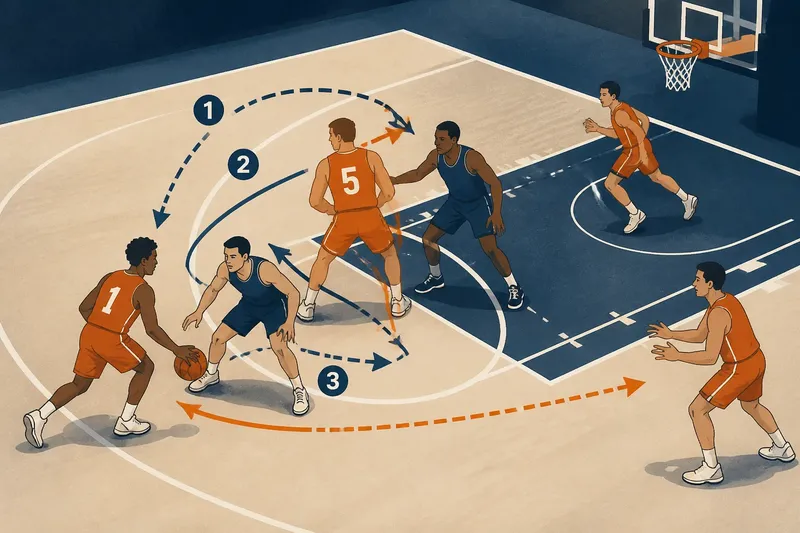
In man-to-man defense, each defender is primarily responsible for a particular offensive player. If that player cuts across the court, the defender generally follows. Teammates can help when the opponent drives or gets past a defender, but the original matchup remains the starting point.
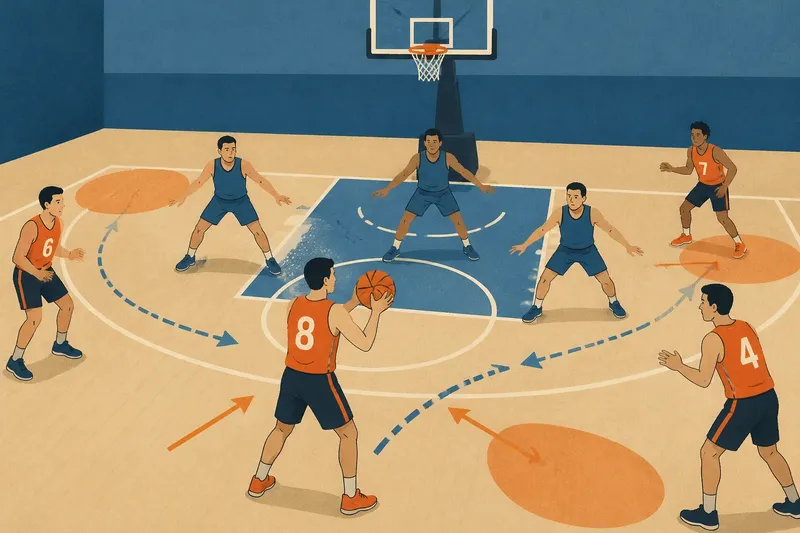
In a zone, defenders are assigned areas rather than one opponent. They watch for players entering those areas, then pass responsibility as the offense moves. A defender may briefly track an opponent without becoming that player’s permanent shadow.
The practical difference is not that man-to-man has no help or that a zone ignores individual players. Both require communication and shared responsibility. The question is what triggers a defender to move: an opponent’s route in man-to-man, or an opponent’s arrival in a zone’s area.
Which spaces does a zone tend to leave open?
A zone often protects the space near the basket by positioning several defenders between the ball and the rim. That can make a straight-line drive feel crowded. The cost is that the defenders are spread across areas, so space may appear between them or beyond the perimeter, depending on the zone’s shape and the ball’s location.
In a common two-three alignment, two defenders begin higher and three closer to the basket. The arrangement can make the middle and the rim feel occupied, while the corners or the area around the top may become available when defenders shift toward the ball. A pass can force that shift, but a quick reversal may send the defense moving again before it is set.
That does not mean every corner is automatically open. A nearby defender may close out, and a teammate may rotate to cover the space that defender leaves. The opening is often a brief window, not an empty square waiting politely for a shot.
Read the gaps between defenders, not just the positions of their feet.
Which spaces does man-to-man tend to leave open?
Man-to-man can keep a defender close to each opponent, but that attention can pull defenders away from other parts of the court. If a ball handler beats the first defender, help may come from a teammate who was guarding someone else. The space that teammate leaves can become an opening for a pass or cut.
A drive from the wing, for example, may draw help from a defender near the lane. That defender’s assignment can then move into the vacated area, creating a choice: stay with the ball, recover to the original player, or rely on another teammate to rotate. The defense is trading one space for another while trying to make the offense act under pressure.
Man-to-man also tends to give the offense clearer individual matchups to attack. An offensive player may try to isolate a slower defender or use movement to make a defender trail behind. The defense can switch assignments or bring help, but either choice can create a new mismatch or leave an opponent temporarily unattended.
How does ball movement change the open space?
Ball movement shifts both kinds of defense, but it changes their responsibilities differently. Against a zone, the ball makes defenders slide toward its location, so a pass across the court can expose the far side if the shift takes time. Against man-to-man, a pass does not automatically move every defender in a line; each defender must stay attached, anticipate a cut, or help a teammate.
Imagine a hypothetical offense passing from the left wing to the top, then quickly to the right corner. Against a zone, the expected opening is the far-side corner or the seam between two shifting defenders, depending on the alignment. Against man-to-man, the expected opening may be the lane a cutter uses while defenders turn to track the ball and their assignments. The observable result to look for is not simply whether a shot appears, but which defender had to leave a space to prevent it.
A slow pass gives either defense more time to recover. A sharp pass followed by a cut asks defenders to solve two moving problems at once.
What should an offense do against each defense?
Against a zone, offenses commonly try to move defenders away from one another and place a receiver in a gap. A player at the high post can receive the ball between the upper and lower lines, then look for a shot, a pass to the baseline, or a kick-out if defenders collapse. Reversing the ball can also make the defense cover more ground.
Against man-to-man, the offense can use cuts, screens, and changes of direction to make defenders follow, switch, or seek help. A backdoor cut can exploit a defender watching the ball rather than the player. A screen can create separation, although the defender’s response—such as going around it or switching—determines what space opens next.
These are tendencies, not recipes. A disciplined zone can close gaps quickly, while a coordinated man-to-man defense can help and recover without surrendering an easy pass. Offenses need to read the defenders’ actual movement rather than assume the label tells them what will happen.
How can you tell which defense is being played?
Watch what defenders do when an offensive player moves away from the ball. In man-to-man, the defender will usually travel with that player, at least until a switch or help assignment changes the matchup. In a zone, the defender is more likely to hold position and let the player pass into another teammate’s area.
Then watch the defense after a pass. If defenders shift together according to the ball’s position while maintaining their zones, that is a clue. If each defender remains closely connected to a particular opponent, even as the ball moves elsewhere, man-to-man is more likely.
One moment can mislead. A man-to-man defense may switch on a screen, and a zone defender may step out to challenge a receiver. Follow the pattern across several movements before deciding.
What questions help read a defense during play?
Does a zone always leave the three-point line open?
No. A zone may concede some perimeter attempts as a trade for crowding the lane, but its defenders can close out on shooters. The relevant question is whether the pass reaches a shooter before the nearest defender can contest the space.
Can man-to-man defense become a zone?
A team can change schemes or use temporary rotations that resemble a zone. Help defense may also make several players converge in one area, but that alone does not mean their original assignments have changed permanently. Watch who picks up an opponent after the ball moves away.
Why does the corner matter against a zone?
The corner can be distant from the defenders guarding the middle, so a quick pass may test how fast the zone shifts. It is not automatically a clean shot: the nearest defender may already be positioned to close out, and a pass to the corner can limit the receiver’s options.
Which defense is better against a fast offense?
Neither is inherently better in every situation. A zone can keep defenders organized around the basket, while man-to-man can make it harder for opponents to settle into an unguarded area. The answer depends on how well the defenders communicate and whether the offense can exploit the space each scheme gives up.
How should you compare the two while watching?
Track three things: who moves with the off-ball player, where help comes from, and what space opens after help arrives. That sequence reveals more than the initial formation. A defender leaving a corner to stop a drive may be the decisive moment, whether the team began in a zone or man-to-man.
For a quick read, pick one offensive player away from the ball and follow that player through a pass and a cut. If the same defender stays attached, man-to-man is likely; if responsibility passes according to location, a zone is likely. Then look at the space the defense has chosen to protect and the space it is willing to risk.
That is the useful distinction in zone defense vs. man-to-man: one organizes protection around areas, the other around opponents, and both reveal their priorities through the gaps they leave behind. When a shot or drive succeeds, notice not only who took it, but which space the defense had to surrender to prevent something else.