Why Tennis Has a Tiebreak When a Set Stalls
Why tennis has a tiebreak: understand how the format resolves a level set, limits open-ended play, and preserves a clear finish without changing the game.
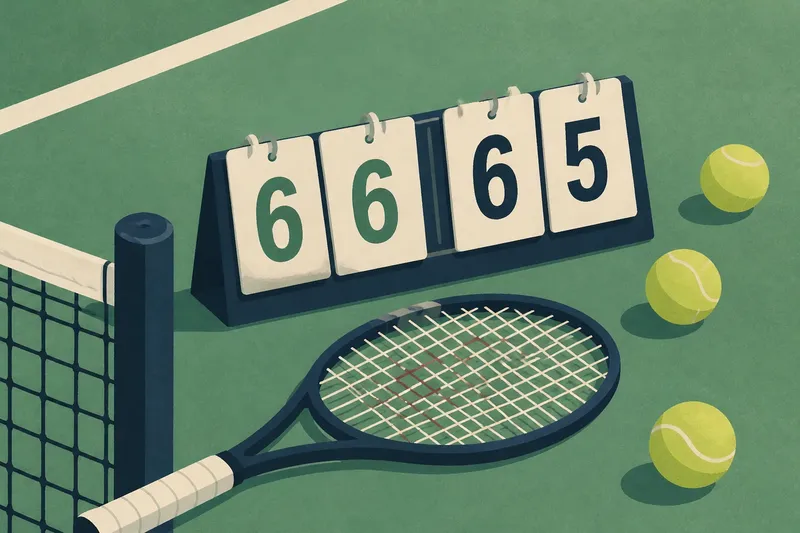
The common mistake is to treat a tennis tiebreak as a miniature match added for drama. It is a format device: when a set reaches its prescribed score, the tiebreak provides a bounded way to decide who takes it. Why tennis has a tiebreak comes down to the problem of a set that can otherwise keep extending as players trade games.
1. What problem does a tiebreak solve?
In a standard set, a player generally must reach six games and lead by two. At six games apiece, neither player has that margin, so the set continues. If each player keeps holding serve, the score can advance through more games without producing a winner.
That rule rewards a player for establishing a clear advantage, but it leaves the endpoint open. A tiebreak supplies a specific finish once the set reaches its trigger score, commonly six games all in formats that use this procedure. The set no longer depends on one player breaking serve before play can move on.
The distinction matters: the tiebreak does not decide whether the players are tied in the match. It decides the set, after the ordinary game-based scoring has reached a point where its two-game margin has not appeared.
2. Why not simply stop at six games all?
Stopping at six games all would be quick, but it would leave the set level. A format needs a way to award the set to one player, not merely to record that both have won the same number of games. The tiebreak adds a final contest that gives the score a decisive owner.
Nor is the alternative of playing games indefinitely a neutral choice. The players still compete under the same rules, but the set’s duration becomes harder to anticipate. That uncertainty affects match scheduling, recovery between sets, court availability and the practical limits of an event.
A tiebreak therefore balances two aims that pull in different directions: a set should require a meaningful advantage, yet a match also needs a workable boundary. It is not a claim that every long set is unfair; it is a choice about how much open-endedness a format can accommodate.
3. How does the tiebreak change the shape of a set?
Ordinary games are organized around service turns and the familiar point sequence. A tiebreak keeps tennis points and alternating service, but changes the scorekeeping: points are counted numerically, and the first player to reach the specified target must also lead by two. In a common tiebreak, that target is seven.
Because the target is not an absolute stopping score, the tiebreak itself can continue if the players remain level near the end. The format closes the set’s open-ended game sequence by replacing it with a smaller contest that still requires a margin. It limits the route to a decision; it does not promise an exact finishing point.
Service turns also matter more visibly within that short contest. The first server begins with one point, then service alternates in two-point turns. A spectator can follow the score while keeping track of whose service turn is coming, rather than treating every point as interchangeable.
4. What does the tiebreak preserve, and what does it trade away?
The tiebreak preserves the need to win points under pressure and the need to lead by two at the finish. It also retains the role of serve, return, and point-by-point execution. What changes is the scale: instead of trying to create a two-game lead, the players settle the set through a concentrated sequence of points.
That concentration makes the set’s final phase easier to schedule and easier to identify. It also means that a small number of points can determine the set, unlike a format that allows the players to continue accumulating games until a larger game margin appears. Neither design removes chance or pressure; each locates the decisive stretch differently.
Imagine a fictional match in which both players hold serve through six games each, then continue exchanging games. Under a tiebreak format, reaching the set’s trigger score sends them into the point-based decider, and the winner takes the set without waiting for a two-game lead in ordinary games. The observable result is a distinct endpoint, not a change to who won the earlier games.
5. Which tiebreak details should a reader check?
“Tiebreak” can refer to different procedures, and tournament formats may use distinct rules for an ordinary set-ending tiebreak and a deciding-set tiebreak. The set score alone does not tell you the point target or when the tiebreak begins. The event’s format and applicable rules settle those details.
- Trigger score: Check which game score starts the tiebreak. Do not assume every set uses the same trigger.
- Point target: Look for the stated target and whether the player must lead by two points.
- Service order: Note who serves first and how service changes during the tiebreak.
- Deciding set: Check whether the final set uses the same procedure as earlier sets or a different one.
- Match format: Confirm whether the event’s rules use a tiebreak to decide a set or a separate procedure to decide the match.
These checks explain why two matches can both mention a tiebreak yet finish under different details. The name describes a role, not one universal set of instructions.
What do viewers often ask about tennis tiebreaks?
Does a tiebreak count as a game?
Yes. It decides the final game of the set, so the set score records that game for the tiebreak winner. The points inside it are counted numerically rather than with the ordinary game score.
Can a tennis tiebreak keep going?
Yes. If the players reach the target without a two-point lead, they continue until one has that margin. The tiebreak has a defined scoring method, not necessarily a fixed number of points.
Does every tennis set use a tiebreak?
No. The event’s format determines whether a set uses one and at what score it begins. A deciding set may follow a different procedure from the sets before it.
Why is the tiebreak not just another game?
It is the set’s final game, but its points use a different count and service pattern from an ordinary game. That change creates a compact decider while retaining a two-point margin at the finish.
Why the format choice is easy to miss
On a scoreboard, the tiebreak can look like an unusual ending attached to an otherwise familiar set. Its real purpose is structural: it replaces a potentially open run of games with a defined point contest once the set reaches its trigger score. That is why tennis has a tiebreak, and why the exact procedure belongs to the format rather than to one rule that applies everywhere.
When watching, read the set score first, then check the event’s tiebreak rule if the final set is in play. That small habit tells you whether the players are approaching a familiar decider or a different ending altogether.